On this page
Key facts
- Trucks compared
- Suzuki Carry, Daihatsu Hijet, Honda Acty, Subaru Sambar, Mitsubishi Minicab
- Rated load
- 350 kg (about 770 lb) for all five
- Engines
- 656 to 659 cc; three cylinders, except the four-cylinder Sambar
- Size of 1999-on trucks
- About 3,395 x 1,475 mm (133.7 x 58.1 in)
- Importable now
- Built October 2001 or earlier, as of October 2026
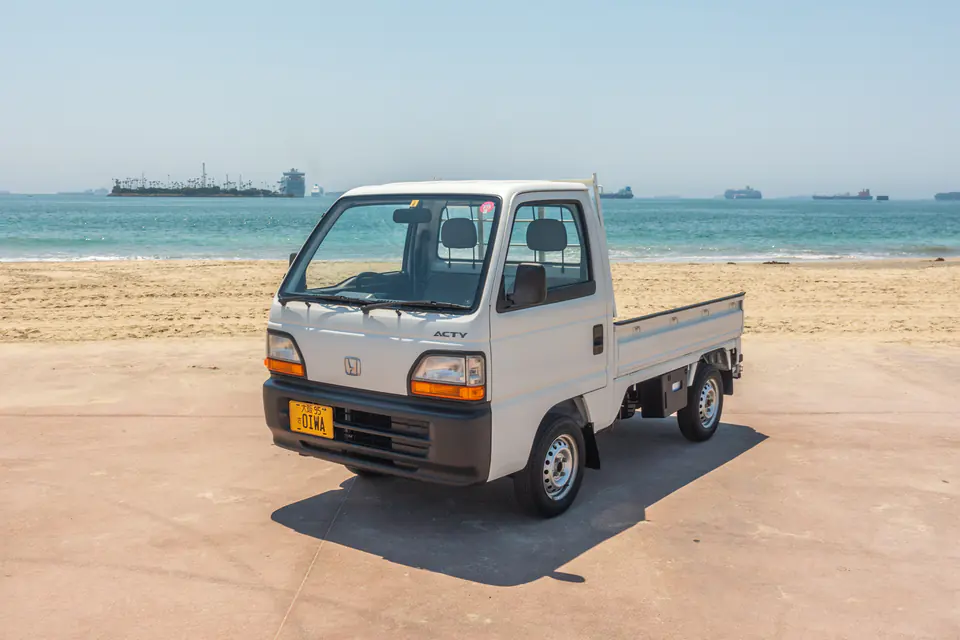
Honda Acty
Engine under the bed, smooth ride, deep parts supply.
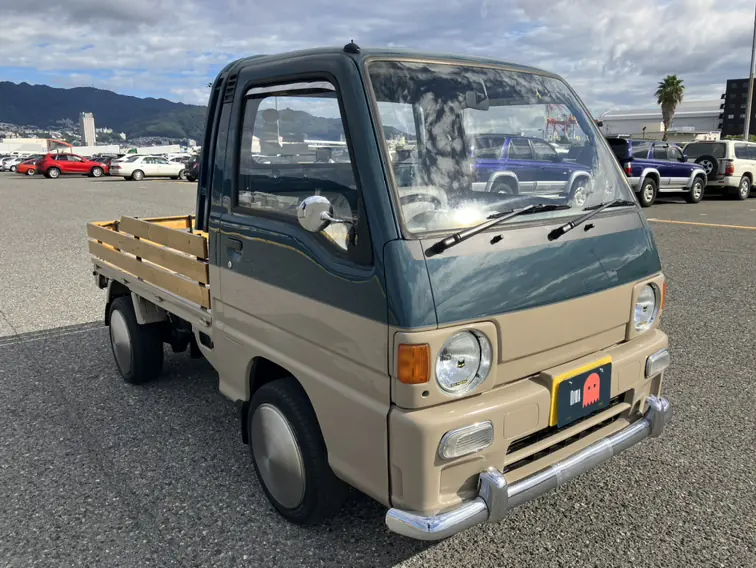
Subaru Sambar
Rear engine, four-wheel independent suspension, supercharged versions.
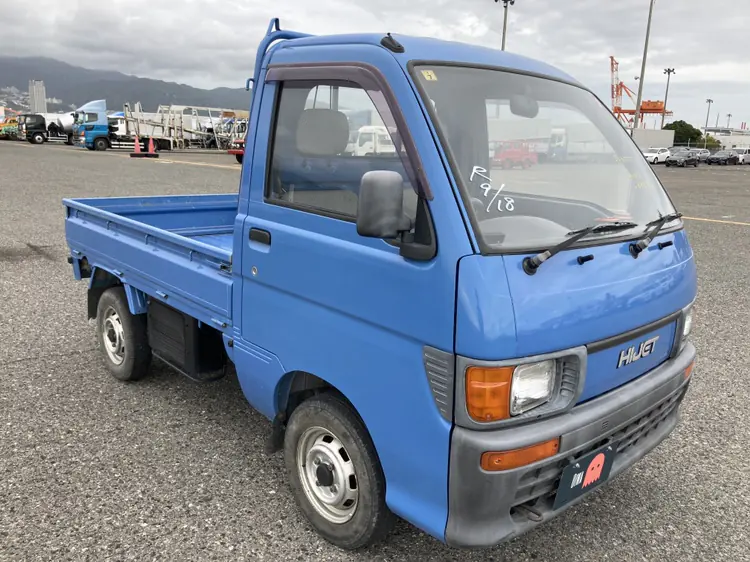
Daihatsu Hijet
Simple, tough and still built in Japan today.
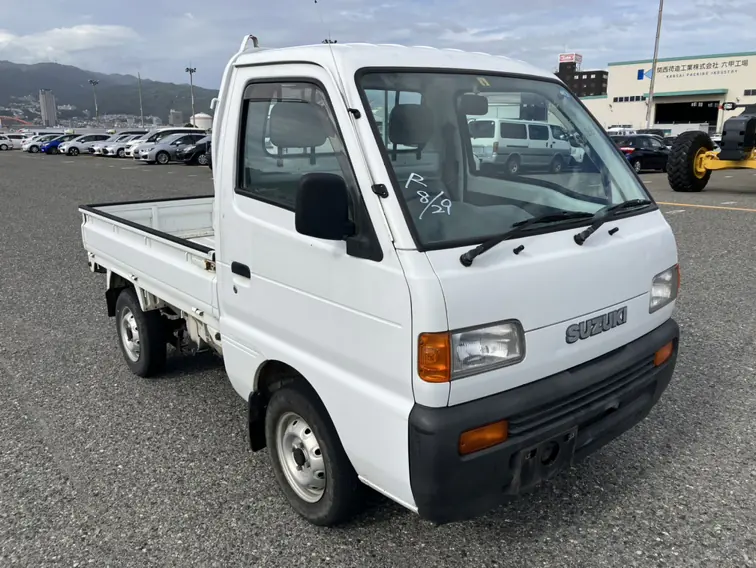
Suzuki Carry
Light, nimble and backed by a big aftermarket.
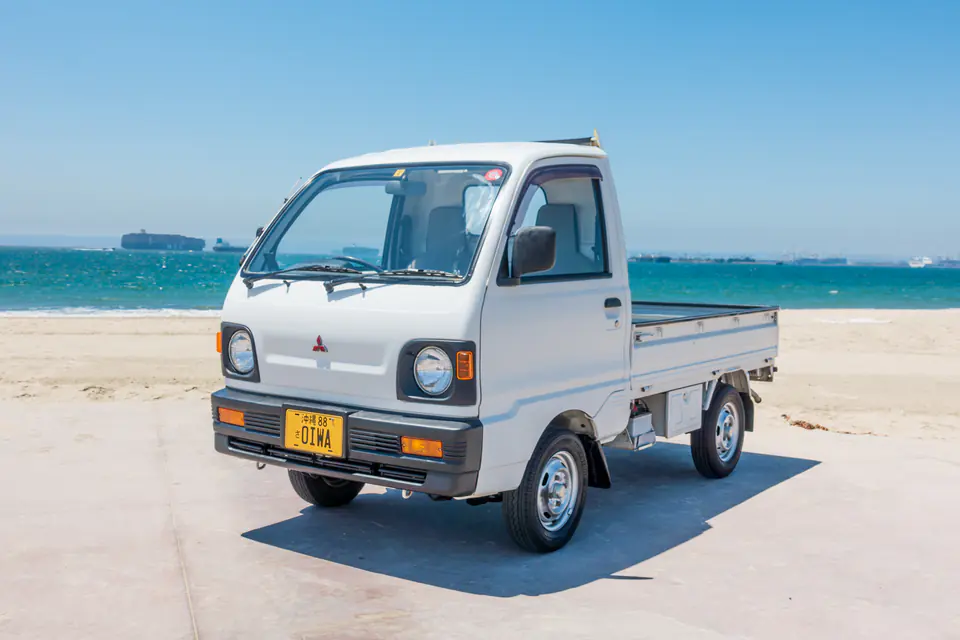
Mitsubishi Minicab
Round headlights and a long production run.
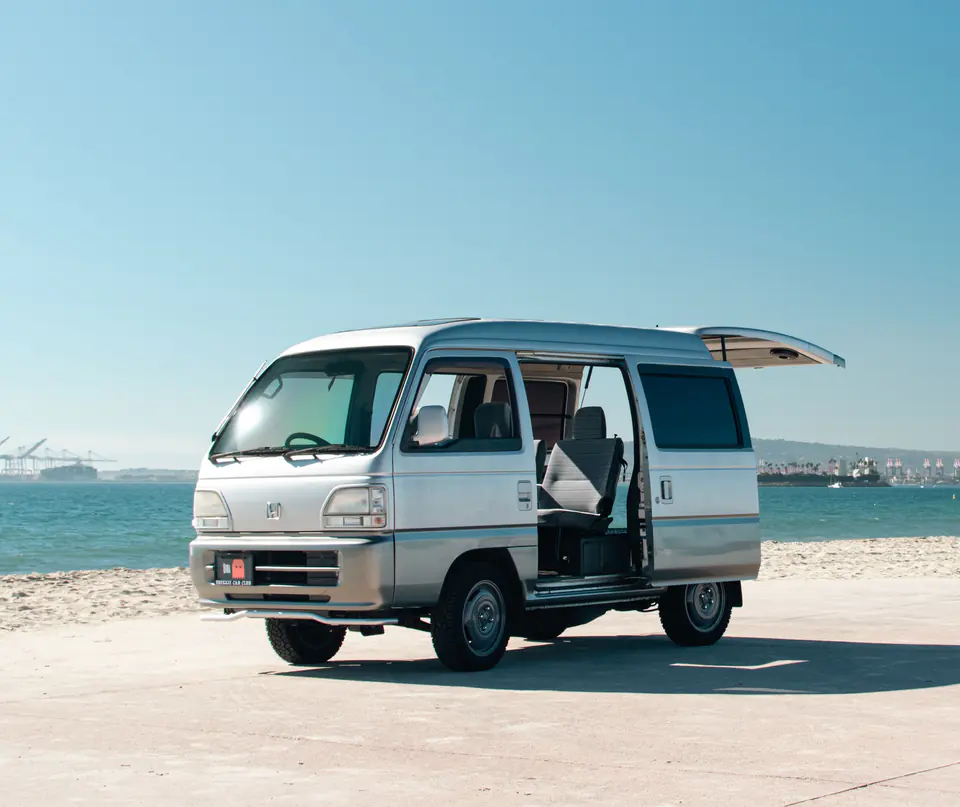
Kei Vans
The same platforms with a roof, seats and sliding doors.
All five Kei Trucks you can import were built to the same Japanese size rules, carry the same 350 kg rated load and run engines between 656 and 659 cc. What separates them is where the engine sits, how the 4WD works, how the truck rides and how easy it is to keep running in the US. This guide compares the five, then matches each one to a job.
Which Kei Truck should you buy?
All five carry the same 350 kg rated load, so pick the model by the job, then pick the individual truck by its condition. The short version:
- For most buyers: the Suzuki Carry. Suzuki built it in huge numbers, its F6A engine is simple, and it has the widest US parts and aftermarket support.
- For farm and ranch work: a 4WD Daihatsu Hijet or Carry with a 5-speed and a low range, or a factory dump bed if you move loose material.
- For paved roads: the Honda Acty or Subaru Sambar. The Acty's midship engine and the Sambar's four-wheel independent suspension make them the calmest on pavement.
- For tall drivers: a Hijet with the Jumbo cab.
- For a tight budget: the Mitsubishi Minicab, or a 2WD version of any of the five.
None of that outranks condition. A sound frame, a recent timing belt and clean paperwork matter more than the name on the tailgate.
How do the five Kei Trucks compare?
The table compares the five on layout, engine, 4WD, ride, cab room and US parts supply; every engine falls between 656 and 659 cc.
| Truck | Engine location | Engine | 4WD | Ride | Cab room | US parts supply | Best for |
|---|---|---|---|---|---|---|---|
| Suzuki Carry | Under the seats | F6A, 657 cc, 3-cyl | Part-time; hi/lo range or extra-low gear on most 4WD manuals | Firm | Standard | Deepest | All-round use, off-road builds |
| Daihatsu Hijet | Under the seats | EF, 659 cc, 3-cyl | Part-time; low range on some | Firm | Jumbo cab option | Good | Farm work, dump beds, tall drivers |
| Honda Acty | Midship, under the bed | E07A or E07Z, 656 cc, 3-cyl | Real-time 4WD on HA4 and HA7; Attack trim adds ultra-low gear and rear diff lock | Balanced, quieter cab | Standard | Deep | Road use, steep ground (Attack) |
| Subaru Sambar | Rear | EN07, 658 cc, 4-cyl; supercharged option | Part-time on manuals, many with an extra-low first; full-time on some automatics | Smoothest; independent suspension at all four wheels | Standard | Thinner | Road use, comfort |
| Mitsubishi Minicab | Under the seats | 3G83, 657 cc, 3-cyl | Part-time; hi/lo range on many 5-speed 4WD trucks | Firm | Standard | Thinner | Budget buys |
The parts column reflects how quickly body and model-specific parts turn up in the US. Filters, belts, plugs and brake parts are easy for all five, and Oiwa Garage stocks Kei Truck parts for every make in this table.
Suzuki Carry
Nearly every 660 cc Carry you can import runs the F6A three-cylinder, from the DC51T/DD51T trucks built from 1991 into early 1999 to the DA52T/DB52T trucks Suzuki launched in January 1999. Suzuki's spec sheets rate the carbureted engine at 42 PS and the fuel-injected 4WD version at 50 PS, and a 56 PS turbo was also offered. The chain-driven K6A replaced the F6A in late 2001, so only the earliest K6A trucks are reaching the 25-year line now. Mazda sold the same truck as the Scrum.
Daihatsu Hijet
The Hijet uses Daihatsu's 659 cc EF three-cylinder under the seats. Japanese catalog data rates the S200P/S210P generation, launched in January 1999, at 43 PS in its first year. The Jumbo is the Hijet's signature option: a stretched cab with space behind the seats, so the seats slide back and recline further. Factory dump beds are a common Hijet configuration. Toyota later sold the Hijet as the Pixis Truck, and every Subaru Sambar built since 2012 is a Hijet underneath.
Honda Acty
Honda mounted the Acty's engine midship, under the bed and ahead of the rear axle. That keeps engine heat and noise out from under the seats and spreads weight more evenly than the under-seat layouts. Honda rated the E07A in the 1990-1999 HA3/HA4 trucks at 38 PS and the E07Z in the HA6/HA7 trucks, which arrived in May 1999, at 46 PS. The Attack is the hill-farm special: Honda's 1994 release lists an ultra-low gear, an ultra-low reverse and a rear diff lock. Honda never rebadged the Acty and stopped building the truck in April 2021.
Subaru Sambar
The Sambar carries its engine behind the rear axle and is the only Kei Truck here with four cylinders: the 658 cc EN07. All four wheels have independent suspension, where its rivals use leaf springs at the rear. Naturally aspirated versions were rated at 40 to 48 PS depending on year, and supercharged trucks at 55 PS (KS3/KS4) and 58 PS (TT1/TT2). Skip the ECVT automatic sold from 1990 to 1995; Subaru replaced it with a conventional 3-speed automatic in October 1995 after durability problems in commercial use. Subaru built the Sambar itself until February 2012.
Mitsubishi Minicab
The Minicab runs Mitsubishi's 657 cc 3G83 three-cylinder under the seats. Catalog data rates carbureted U41T/U42T trucks at 42 PS and the fuel-injected U61T/U62T generation, launched in February 1999, at about 48 PS, and a 64 PS turbo 3G83 existed in that generation. Nissan sold a Minicab-based Clipper from 2003 to 2013, and Minicab trucks built since 2014 are rebadged Carrys. Fewer US shoppers ask for the Minicab by name, which often keeps its price below a comparable Carry or Acty.
Which Kei Truck is best for farm and ranch work?
A 4WD Hijet or Carry with a 5-speed manual and a low range is the usual farm setup. Low gearing matters more than horsepower when you creep along a fence line or climb a muddy lane with a full bed, and both trucks offer it on many 4WD versions. The Hijet adds the Jumbo cab and plenty of factory dump beds.
- Pick the transmission first. A 5-speed manual with a low range will out-work a 3-speed automatic on hills and in mud.
- Inspect dump hydraulics. On a dump bed, check the pump, hoses, ram and pivot pins, then cycle the bed up and down.
- Consider an Acty Attack for steep ground. Its ultra-low gear and rear diff lock suit hill pastures and woodlots.
- Respect the 350 kg limit. Water, feed and fencing add up fast. A full 100-gallon water tank weighs about 834 lb, more than the truck's rated load.
Which Kei Truck is best for hunting and off-road?
Stock ground clearance is modest: Suzuki lists 160 mm (6.3 in) for the 1999 Carry, and Honda lists 190 mm (7.5 in) for the 2003-2007 Acty. Within that limit, a 4WD Carry is the easiest truck to build for rough ground, because it has the largest selection of lift kits, wheels, tires and bumpers in the US. The Acty Attack brings the strongest factory hardware for slow, steep terrain. A 4WD Sambar puts its engine weight over the driven rear wheels, which helps on loose climbs.
A small lift and slightly larger tires buy useful clearance, and Oiwa Garage carries Kei Truck lift kits for all five makes. Check your state's rules on lift height before going big. Our Kei Truck off-road guide covers 4WD use, tire pressures and recovery.
Which Kei Truck is best for road use?
On 45 to 55 mph roads, the Sambar and Acty are the most pleasant to drive, where your state allows road use at all. Check the Kei Truck laws by state first, since some states limit these trucks to lower-speed roads. The Sambar's four-cylinder runs smoother than the triples, its independent suspension soaks up broken pavement, and a supercharged Sambar adds useful power for hills and merging. The Acty's midship engine keeps the cab quieter and cooler.
Whatever you pick, favor a 5-speed manual. Every engine here works hard at 50 mph, and five ratios help keep it in its power band on hills. The 1999-2001 trucks are also 80 mm wider than the 1990s trucks, and the Carry, Acty and Minicab of that generation gained 370 to 520 mm (about 15 to 20 in) of wheelbase, which tends to calm the ride at speed.
Which Kei Truck fits a tall driver?
The Hijet Jumbo is the best answer, because its stretched cab adds room behind the seats that no standard 1990s or 1999-2001 cab offers. Jumbos are a small share of the trucks for sale, so be ready to move when a clean one appears.
If you can't find a Jumbo, sit in the truck before you buy. Seat travel, headroom and pedal position vary by model and generation. Wearing your work boots, check that your knees clear the steering column and that you can push the clutch to the floor without your foot catching on anything.
Which Kei Truck hauls the most, and which costs the least?
For hauling, the five are close to equal on paper: each is rated for 350 kg, and beds from the same era are nearly identical. Suzuki and Honda both list 1,940 x 1,410 mm beds for their 1999-on trucks and 1,940 x 1,330 mm beds for their 1990s trucks. Choose by bed type instead of badge. A standard drop-side bed loads from either side or the back, a dump bed unloads gravel and mulch without a shovel, and a Jumbo cab gives up some bed length for cab space. Our Kei Truck specs page lists bed sizes and weights in detail.
For the lowest price, look at the Minicab and at 2WD trucks of any brand. Both draw fewer US buyers than 4WD Carrys and Actys, so they tend to cost less for the same condition. Keep money aside for a timing belt, tires and fluids, which will matter more to your total than a few hundred dollars saved on the truck.
What matters more than the badge?
Four checks decide whether any Kei Truck is a good buy:
- Build month. As of October 2026, a truck built in October 2001 or earlier can be imported under the 25-year rule. Confirm the month on the chassis plate or export certificate.
- Your state's rules. Whether you can plate the truck depends on where you live.
- Rust. Look hard at the frame rails, bed floor, cab corners and rocker panels.
- Timing belt and service history. Every engine here except the late-2001 K6A uses a timing belt, so budget a Kei Truck timing belt kit unless there is proof the job was done.
Our Kei Truck buying guide walks through the paperwork and inspection. If you need an enclosed box instead of a bed, compare the Kei Vans built on these same platforms.
Find parts for your truck
Pick your model and chassis code. We'll send you to the right Oiwa Garage collection.
Frequently asked questions
What is the most reliable Kei Truck?
All five use simple engines that were built for commercial work, so reliability depends far more on the individual truck than on the badge. A rust-free truck with a recent timing belt and clean fluids is the reliable one. Among the designs, steer clear of the Sambar's 1990-1995 ECVT automatic, which Subaru itself dropped after durability problems.
Which Kei Truck has the best 4WD?
For slow, steep work, the Honda Acty Attack stands out because Honda fitted it with an ultra-low gear and a rear diff lock. For general off-road use, a 4WD Carry with a hi/lo transfer case is the easiest to find and to upgrade. Most 4WD Kei Trucks use part-time systems meant for loose surfaces, not dry pavement.
Is the Subaru Sambar worth paying more for?
It can be if you drive on pavement. The Sambar is the only Kei Truck with a four-cylinder engine, four-wheel independent suspension and a factory supercharger option, so it rides and cruises better than its rivals. For pure farm work the advantage shrinks, and model-specific Sambar parts can take longer to source in the US.
Are 1999-2001 Kei Trucks better than 1990s trucks?
They are wider, longer and usually better equipped, with fuel injection on most engines, and several have much longer wheelbases that calm the ride. The 1990s trucks are simpler, a little lighter and often carbureted, which some owners prefer for home repairs. Both generations are importable as of October 2026 if the specific truck was built in October 2001 or earlier.
Which Kei Truck is easiest to find parts for?
The Suzuki Carry and Honda Acty have the deepest US parts support, with the Daihatsu Hijet close behind. Wear items such as filters, belts, spark plugs and brake parts are easy to get for all five. Body panels, trim and model-specific parts for the Sambar and Minicab more often come from Japan, so allow extra time.
Can you get a Kei Truck with an automatic transmission?
Yes, but automatics are the minority. Suzuki, Honda, Subaru and Mitsubishi all offered 3-speed automatics on trucks of this era, and some 1999-on Minicabs had a 4-speed. By Suzuki's 1999 gear ratios, the 3-speed automatic turns about 7 to 12 percent more rpm at cruise than the matching 5-speed and has fewer ratios for hills.