On this page
Key facts
- Maker
- Daihatsu Motor Co.
- Years sold in Japan
- 1960 to today (current S500P/S510P since September 2014)
- US-importable now (as of Oct 2026)
- Trucks built October 2001 or earlier: S80P/S81P, S82P/S83P, S100P/S110P and early S200P/S210P
- Chassis codes
- S80P/S81P (1986-1990), S82P/S83P (1990-1994), S100P/S110P (1994-1999), S200P/S210P (1999-2007), S201P/S211P (2007-2014), S500P/S510P (2014 on)
- Engine(s)
- EB 547 cc (1986-1990); EF 659 cc 3-cylinder with timing belt (1990-2007); KF 658 cc (December 2007 on)
- Layout and drive
- Engine under the seats; rear-wheel drive or part-time 4WD
- 4WD system
- Part-time 4WD; high/low transfer on some 5-speeds; rear super diff lock on the 4WD Extra from January 2001
- Rated load (Japan)
- 350 kg (about 770 lb)
- Rebadged as
- Toyota Pixis Truck (from December 2011); Subaru Sambar Truck (from April 2012)
The Daihatsu Hijet is the oldest nameplate among the five common Kei Trucks, and Daihatsu built it in more work versions than most buyers expect. Here is how the chassis codes line up, which Hijets you can import, and what to inspect.
What is the Daihatsu Hijet?
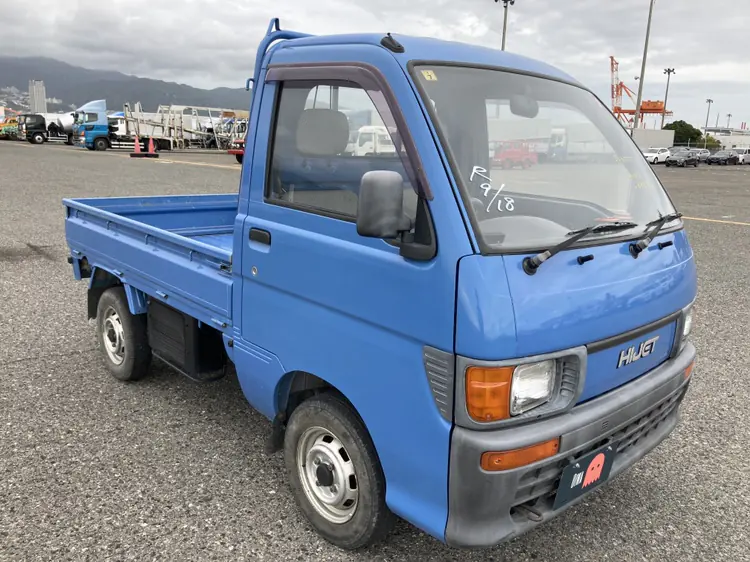
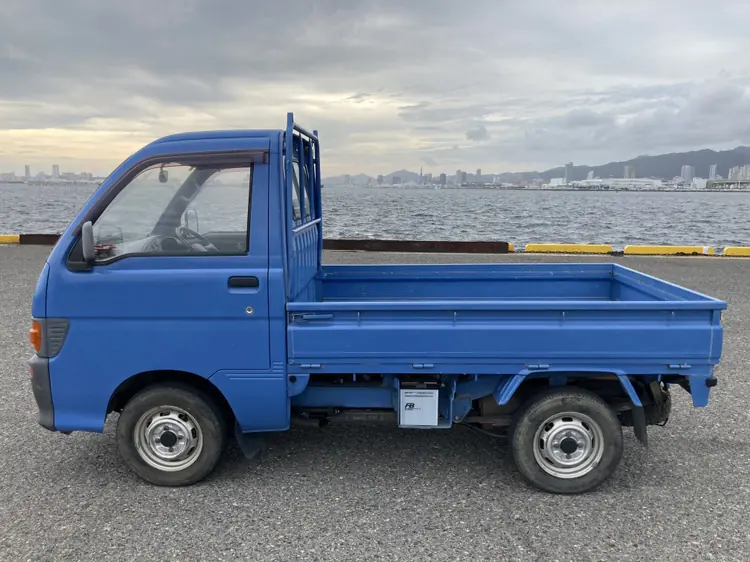
The Daihatsu Hijet is a two-seat cab-over Kei Truck that Daihatsu has sold since 1960. The engine sits under the seats and drives the rear wheels, with part-time 4WD on many trucks. The bed is rated for 350 kg (about 770 lb) under Japan's Kei class rules, the small-vehicle category that caps engines at 660 cc.
Every 660 cc Hijet old enough to import runs Daihatsu's EF engine, a 659 cc three-cylinder with a belt-driven camshaft. Carbureted single-cam versions are rated at about 38-42 PS (metric horsepower, roughly 37-41 hp). Fuel-injected and twin-cam versions are rated a little higher, from about 43 PS up. Trucks from 1986 to 1990 used the smaller 547 cc EB.
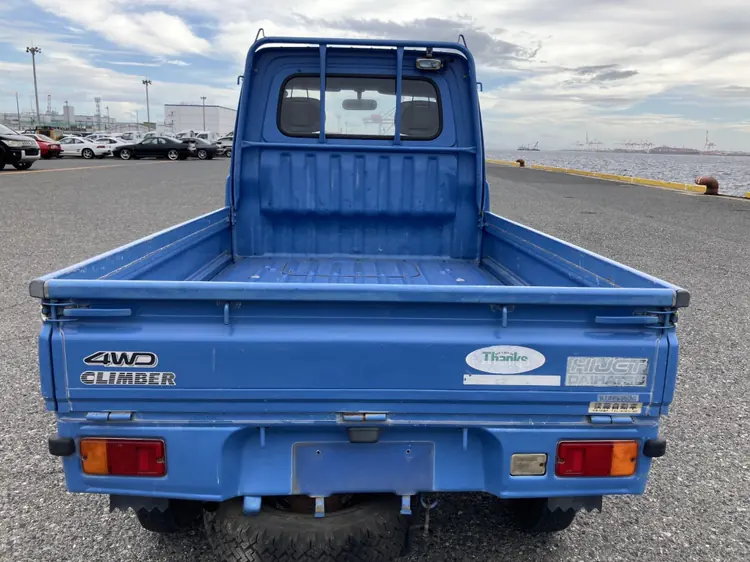
Daihatsu also built a long list of work versions. Alongside the standard bed with three drop sides, you will find factory dump beds, the Jumbo extended cab, the 4WD Climber farm truck, and panel van bodies on the truck chassis.
Toyota and Subaru badges
Toyota has sold the Hijet as the Pixis Truck since December 2011, and the Subaru Sambar Truck has been a Hijet since April 2012. Both are far too new to import, and neither shares anything with the rear-engine Subaru Sambar that Subaru built itself until 2012.
Which Daihatsu Hijet generations can you import?
As of October 2026, any Hijet manufactured in October 2001 or earlier can enter the US under the 25-year rule, the federal exemption from US safety standards for vehicles at least 25 years old. Eligibility is counted from the month the truck was built, whatever its model year. The 25-year rule guide explains how to confirm that date.
In each code pair below, the first code is the 2WD truck and the second is the 4WD truck. The P suffix marks the truck body.
| Generation | Years | Chassis codes | Engine | Notes | US-importable (Oct 2026)? |
|---|---|---|---|---|---|
| 7th gen, 550 cc | May 1986-Mar 1990 | S80P (2WD), S81P (4WD) | EB 547 cc 3-cylinder | Last 550 cc Hijet | Yes |
| 7th gen, 660 cc | Mar 1990-Jan 1994 | S82P (2WD), S83P (4WD) | EF-CS 659 cc, carbureted, about 38-40 PS | 3-speed automatic added in August 1991 | Yes |
| 8th gen | Jan 1994-Jan 1999 | S100P (2WD), S110P (4WD) | EF-NS carbureted (42 PS); twin-cam EF-GS and EF-ZS (44-46 PS) | 5-speed, 5-speed with high/low transfer, or 3-speed automatic | Yes, all |
| 9th gen, EF | Jan 1999-Dec 2007 | S200P (2WD), S210P (4WD) | EF-SE fuel-injected single-cam (43-45 PS); twin-cam EF-VE | Larger body; super diff lock on the 4WD Extra from Jan 2001 | Builds through Oct 2001 |
| 9th gen, KF | Dec 2007-Sept 2014 | S201P (2WD), S211P (4WD) | KF 658 cc | New engine, same body | From Dec 2032 |
| 10th gen | Sept 2014-today | S500P (2WD), S510P (4WD) | KF | CVT automatic from Dec 2021 | From Sept 2039 |
The 1990s trucks are the carburetor years: the S82P and S83P use the carbureted EF-CS, and the single-cam EF-NS in S100P and S110P trucks is carbureted too. The 1999 redesign brought a body sized to the larger Kei class limits Japan adopted in October 1998, and fuel injection on both of its EF engines.
S110P or S210P: which should you buy?
The S100P and S110P are the simpler trucks. Many are carbureted, and they were built to the narrower Kei size rules in force before October 1998. The S200P and S210P bring fuel injection, the larger 1999 body and, on 4WD Extra trucks from January 2001, the super diff lock. Only S200P and S210P trucks built through October 2001 qualify today, and another month of production becomes eligible every month.
For a basic farm truck, an S110P does the job. For more road use or a roomier cab, the S210P is worth the search.
Check your state's rules in the state-by-state Kei Truck laws before you shop, and see how to import a Kei Truck for the paperwork.
What is a Hijet Jumbo, and what other versions are there?
Daihatsu first sold the Hijet Jumbo in June 1983: a longer, taller cab with space behind the seats and room for them to recline, paid for with a shorter bed. Tall drivers look for it because a standard Kei cab is tight on legroom and headroom. Jumbos are harder to find than standard cabs, so expect a longer search for one old enough to import.
The other versions worth knowing:
- Factory dump beds. A hydraulic ram tips the bed for gravel, soil, mulch or snow. These usually cost more than plain beds, so inspect the pump, ram, hoses and hinge pins before you pay for one.
- Climber. A 4WD farm version that Daihatsu first sold in 1982. It is uncommon today.
- Panel vans and other bodies. Enclosed boxes, insulated bodies and other conversions built on the truck chassis. The specialty bodies guide covers what to inspect on each.
What should you check before buying a Daihatsu Hijet?
Confirm the chassis code and build month first, since only Hijets built in October 2001 or earlier can be imported today. An S210P built in November 2001 looks identical to one built in October 2001, but only the October truck can be imported in October 2026. Then go through the truck:
- 4WD. Part-time 4WD should engage cleanly and release without binding. On S110P trucks with the high/low transfer, try low range on gravel. On S210P Extra trucks built from January 2001, test the super diff lock and its indicator.
- The engine under the seat. Lift the seat or engine cover and look for oil and coolant leaks, chafed hoses and a dirty or low coolant tank. Ask for a dated timing belt record.
- Overheating history. Milky oil, white exhaust smoke or a coolant level that keeps dropping all point toward a head gasket. Pressure-test the cooling system if anything looks off.
- Jumbo cabs. Check the roof seams and headliner for water stains, and make sure the seats slide and recline.
- Dump beds. Cycle the bed fully, look for weeping at the ram and hoses, and check the hinge pins and subframe for rust.
- Rust. Look at the frame rails, the cab floor and steps, the door bottoms, the bed floor and the rear crossmember.
Read the auction sheet guide before you bid, and take the checklist from the Kei Truck buying guide to any truck you can see in person.
What are common Daihatsu Hijet problems?
At 25-plus years, most Hijet faults trace back to heat, rubber and rust rather than a weak design.
Timing belt
The EF drives its camshaft with a rubber belt. A common rule of thumb is a new belt every 100,000 km (about 62,000 miles) or 10 years, whichever comes first, and an undocumented belt should be treated as due. Change the tensioner and seals with it, and consider the water pump at the same time. A Kei Truck timing belt kit matched to your engine keeps it to one order.
Heat and cooling
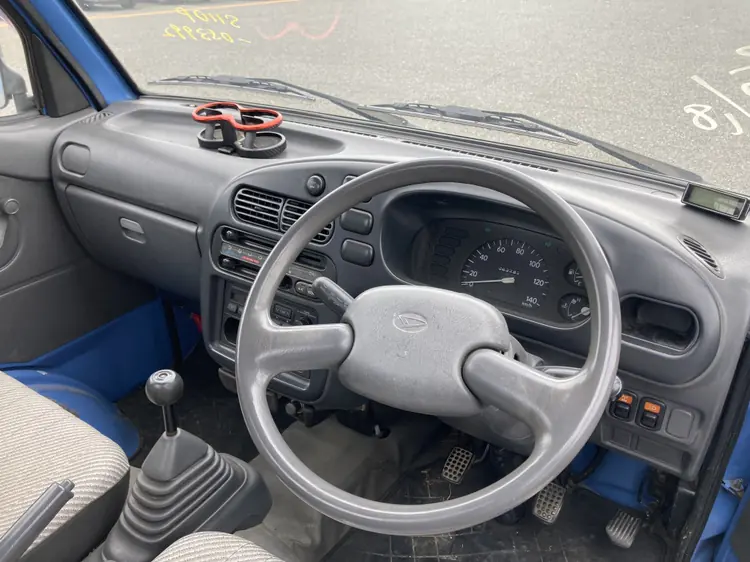
The engine sits directly under the seats, so cab heat in summer is a common complaint, and an engine that runs hot ages its hoses and gaskets faster. Keep the coolant fresh, replace soft or cracked hoses, and add heat insulation under the seats if the cab gets uncomfortable.
Carburetors and ignition
A carburetor that sat with old fuel causes hard starts and a rough idle on S82P, S83P and carbureted S100P and S110P trucks. A cleaning or rebuild usually fixes it. Fresh plugs, wires, cap and rotor clear most misfires.
Clutch, CV boots and electrics
Worked trucks wear clutches, so check where the pedal engages. 4WD Hijets drive the front wheels through CV joints, and a torn boot should be replaced before the joint fails. If you plan to add lights, a winch or a plow, test the alternator and battery first.
Rust
Frame rails, cab floors and bed floors are where Hijets rot. Wash the underside after salted roads and treat chips early. Service intervals are in the maintenance guide.
Where do you get Daihatsu Hijet parts?
Order Hijet parts by chassis code (S83P, S110P, S210P and so on). An S110P and an S210P share the EF engine family, but bodies, brakes and suspension changed with each generation.
Oiwa Garage, the parts store that publishes this guide, sorts Hijet parts by chassis:
- S80 and S81 parts for 1986-1990 trucks
- S82P and S83P parts for 1990-1994 trucks
- S100P and S110P parts for 1994-1999 trucks
- S200P and S210P parts for 1999-2007 trucks
For the first service on a newly imported truck, plan on oil and filter, air and fuel filters, spark plugs, coolant, gear oil and the timing belt.
How does the Hijet compare with other Kei Trucks?
The Hijet shares the conventional layout of the Suzuki Carry and the Mitsubishi Minicab: engine under the seats and a leaf-sprung rear axle. Its strengths are the Jumbo cab and the range of factory work bodies. The Honda Acty mounts its engine between the axles for better balance, and the original Subaru Sambar puts a four-cylinder at the back.
Pick a Hijet if you want a Jumbo cab or a factory work body. The Kei Truck model comparison puts all five side by side.
Find parts for your truck
Pick your model and chassis code. We'll send you to the right Oiwa Garage collection.
Frequently asked questions
What is the difference between an S100P and an S110P Hijet?
Drive layout. In Daihatsu's Hijet codes, the first code of each pair is the 2WD truck and the second is the 4WD truck: S82P and S83P for 1990-1994, S100P and S110P for 1994-1999, and S200P and S210P from 1999. The P marks the truck body. Give the full code when ordering parts, since 2WD and 4WD trucks differ underneath.
What is a Daihatsu Hijet Jumbo?
The Jumbo is a Hijet with a longer, taller cab. Daihatsu first sold it in 1983, and it adds space behind the seats, room for the seats to recline and more headroom, in exchange for a shorter bed. Tall drivers seek it out. Jumbos are harder to find than standard cabs, so expect a longer search for one old enough to import.
Is the Toyota Pixis Truck the same as a Daihatsu Hijet?
Yes. Toyota has sold the Hijet as the Pixis Truck since December 2011, and the Subaru Sambar Truck has been a Hijet since April 2012. Both use Daihatsu engines and parts. Neither can be imported under the 25-year rule yet: the first Pixis Trucks reach 25 years in late 2036 and the first Hijet-based Sambars in 2037.
Can I import a 2001 Daihatsu Hijet?
Yes, if it was manufactured in October 2001 or earlier, as of October 2026. Those trucks are S200P (2WD) or S210P (4WD) models from the generation that launched in January 1999. A truck built in November 2001 or later becomes eligible in the month it turns 25, so confirm the build month before you pay a deposit.
Does the Daihatsu Hijet have a timing belt?
Yes, every EF-engined Hijet does, which covers all 660 cc Hijets from 1990 until the KF engine arrived in December 2007. Replace the belt on arrival unless you have a dated record, and change the tensioner and seals at the same time. A failed belt stops the engine where it stands and can damage the valves on some engines.
What is the Hijet super diff lock?
It is Daihatsu's name for a rear differential lock, which makes both rear wheels turn together for traction in mud, sand or snow. Daihatsu fitted it to the 4WD Extra grade of the S210P from January 2001, and later Hijets offer it on more grades. On an importable truck, confirm the switch and indicator are there and test it on a loose surface.
Sources
- 49 U.S.C. 30112: Prohibitions on noncomplying motor vehicles, including the 25-year exception in (b)(9) (Cornell LII)
- 49 CFR 591.5: Declarations required for importation, including the 25-year declaration in (i) (Cornell LII)
- U.S. Customs and Border Protection: Importing a Motor Vehicle
- r/KeiTruckBuilds owner community