On this page
Key facts
- Factory ground clearance
- 145-190 mm (5.7-7.5 in) on the spec sheets we checked
- Typical 4WD
- Part-time, often with a high and low range
- Rear diff lock
- On some 4WD work trims, including the Acty Attack
- Extra-low gearing
- Acty Attack: ultra-low first and ultra-low reverse
- Factory tire
- 145R12 6PR LT
- Rated load (Japan)
- 350 kg (about 770 lb)
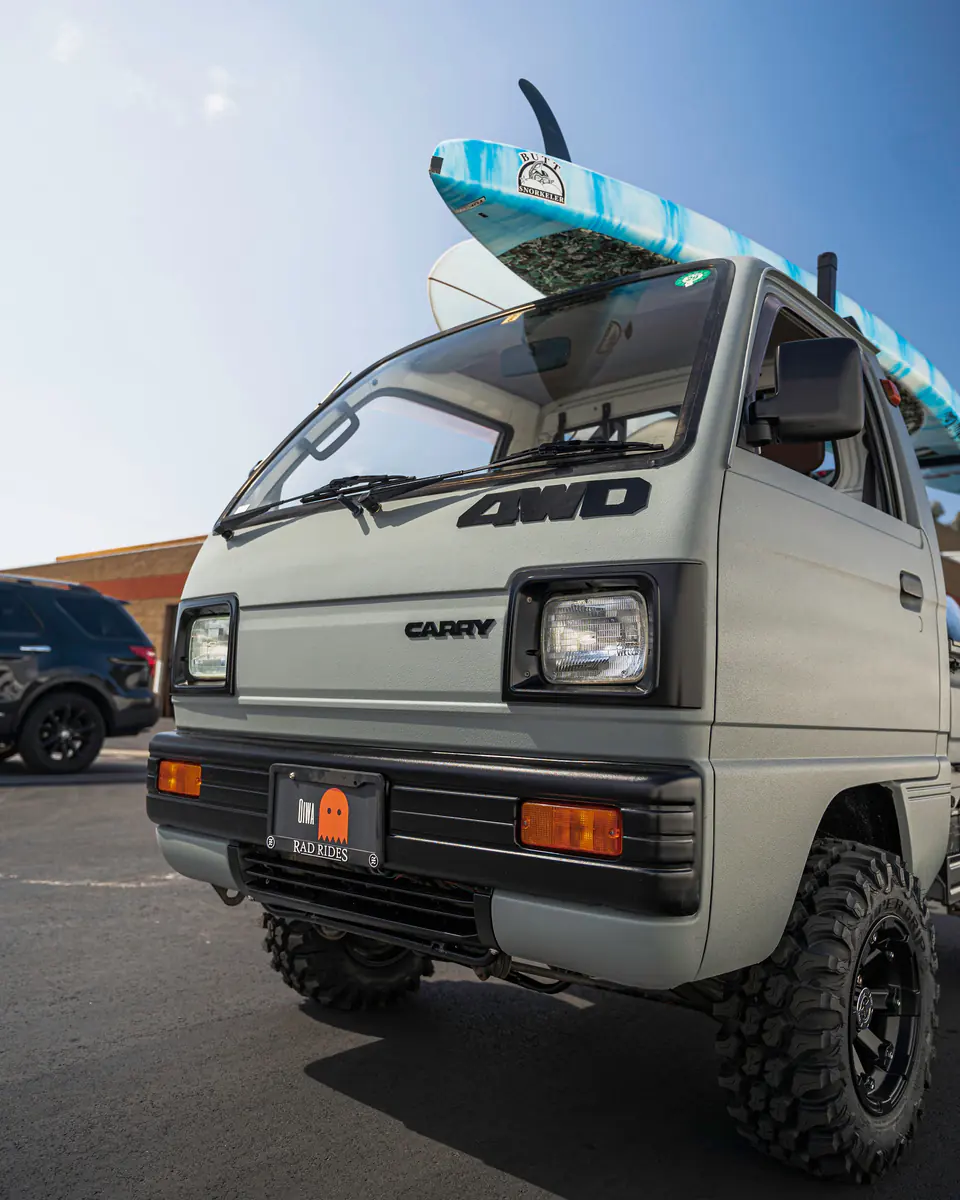
Kei Trucks were built for rough work: Japanese hill farms, orchards, forestry roads and snowy lanes. They are not fast, and their suspension travel is short, so the skill lies in using what they do have. Here is how the drivetrains work, what to fit, and where the limits are.
How good is a Kei Truck off-road?
Very good at working speeds: a 4WD Kei Truck handles farm tracks, mud, snow and forest roads well, but factory ground clearance is only about 145-190 mm (5.7-7.5 inches) and suspension travel is short. Light weight is the big advantage. Curb weights for standard trucks on the spec sheets we checked run from 670 to 870 kg (about 1,480-1,920 lb), so a Kei Truck is gentle on soft ground and fits between fence posts and orchard rows.
The limits are just as real: small brakes with drums at the rear, a short wheelbase, and a cab that sits over or close to the front wheels. If you want to ride fast over broken ground, a UTV suits that job, and the Kei Truck vs UTV comparison covers the trade-offs.
How does Kei Truck 4WD work?
Most 4WD Kei Trucks of this era use part-time 4WD that you select with a lever or button, and many add a low range; Suzuki's January 1999 Carry specification, for example, lists a two-speed high and low transfer on its 4WD trucks. With part-time 4WD engaged, the front and rear axles turn together, which is where the extra grip comes from.
That has consequences:
- Use 4WD only on loose or slippery surfaces. On dry pavement the drivetrain binds in turns, scrubs the tires and strains parts.
- Use low range for steep climbs, slow crawling and heavy loads on hills. Shift into and out of it the way your manual directs, which usually means stopped or barely rolling with the clutch pressed.
- Honda's Acty is a different case: Honda marketed its 4WD as Real Time 4WD, so read the Acty owner's manual rather than assuming it works like a part-time system.
Which Kei Trucks have a diff lock or extra-low gear?
Rear differential locks appear on some 4WD work trims, and Honda's Acty Attack pairs one with an ultra-low first gear and an ultra-low reverse. Honda's February 1994 announcement lists ultra-low and ultra-reverse gears, a rear diff lock and rib-lug tires on Attack versions, and the 2007 Attack specification shows a five-speed manual with the same two extra gears.
A diff lock makes both rear wheels turn together, so one spinning wheel can't leave you stuck. Engage it at low speed in a straight line, and release it on firm ground, because it makes steering heavy and scrubs the tires.
To confirm an Attack, look for UL and UR on the shift pattern, a diff-lock switch, and the grade on the export certificate or auction sheet. A decal proves nothing, since stickers are easy to add. The Honda Acty guide covers the model in depth. Suzuki also built a farm-season Carry grade, listed as the Nohan Carry in its 1999 lineup, with 4WD and a high and low transfer; see the Suzuki Carry guide. On any truck, confirm a lock by finding the switch and testing it on loose ground, since sellers don't always mention one.
What tires and pressures work best off-road?
Start from the pressures on your truck's tire label and adjust a few psi at a time, because a light truck on narrow tires needs only small changes. The factory tire on these trucks is 145R12 6PR LT, a load-rated light-truck tire.
- All-terrain tires in light-truck construction suit mixed farm and road use.
- Mud-terrain tires clear sticky clay better, but they wear faster and hum on pavement.
- Winter tires beat all-terrains on packed snow and ice.
- Keep the load rating, since these trucks often work near their 350 kg (about 770 lb) limit.
- Lower pressure only for soft sand, snow or mud at walking pace, and re-inflate before road speeds.
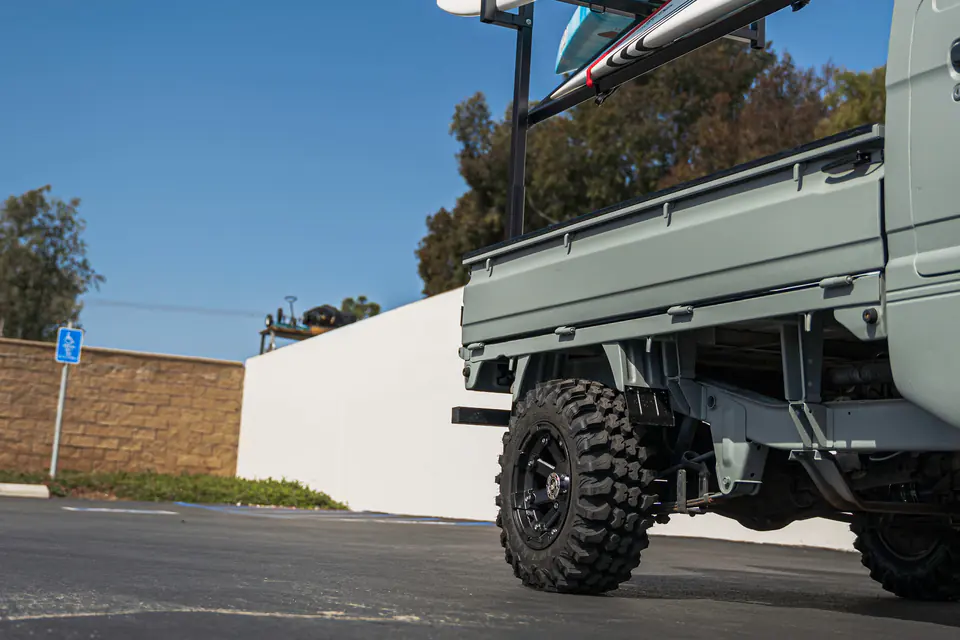
Taller tires are the one change that raises everything hanging from the axles, so a modest size increase does more for clearance under a rigid axle than any body lift.
How much ground clearance does a Kei Truck have?
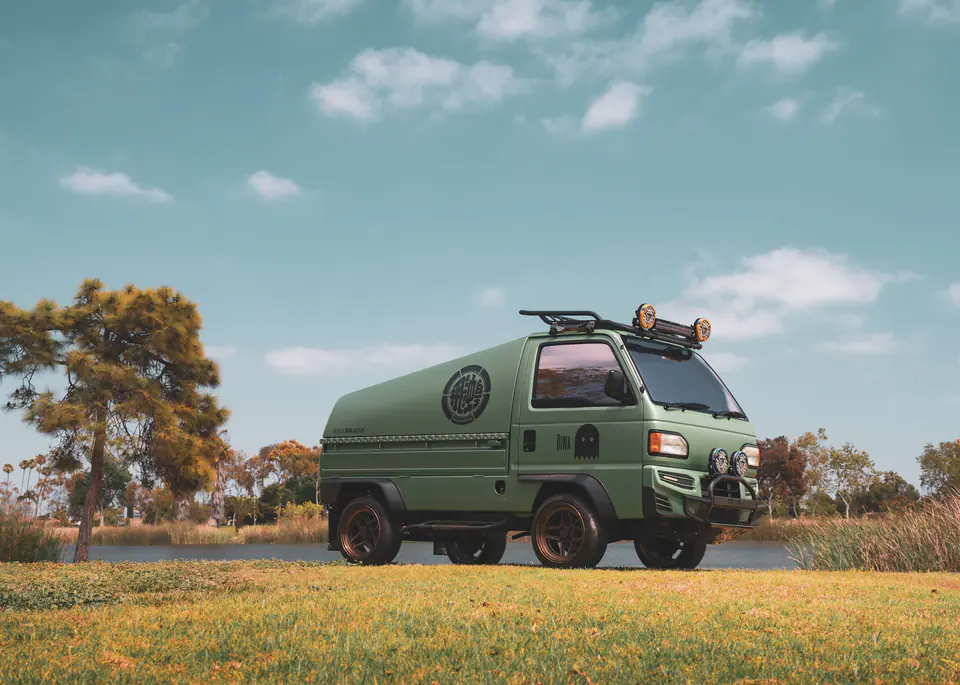
Suzuki's January 1999 Carry specification lists 145-160 mm (5.7-6.3 inches) of minimum ground clearance depending on version, and Honda's 2007 Acty lists 190 mm (7.5 inches). The lowest points are usually the differential housings, then the exhaust and anything hung under the frame.
How much a lift helps underneath depends on the design. A body lift raises only the cab and bed. A suspension lift raises the frame and whatever is mounted to it, but a rigid rear axle's differential stays where the tires put it. Pick lines that put the tires, not the differentials, on the high spots, and fit a skid plate if you drive over rock.
Bolt-on lift kits of about 1.5-2 inches are the common choice for Kei Trucks. The Kei Truck mods guide covers alignment, headlight aim and the legal checks that follow a lift.
Where should you hook a recovery strap on a Kei Truck?
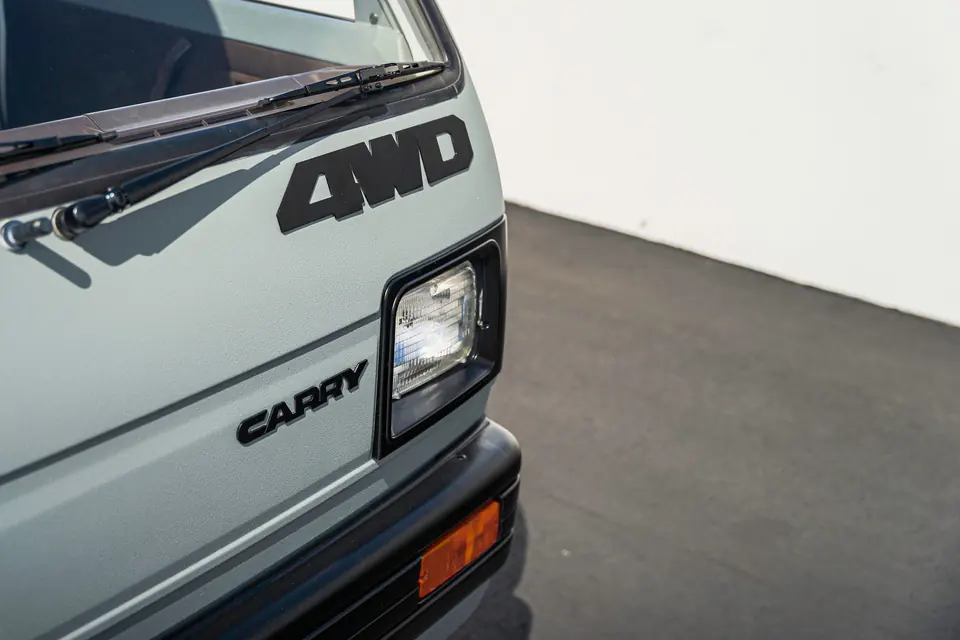
Use the factory tow hooks or a rated recovery point bolted to the frame, never the bed's rope hooks, the mirrors or a bumper cover. Honda's equipment list for the 2007 Acty, for example, includes front and rear tow hooks.
- Choose a steady pull with a strap, a hand winch or a come-along over a running jerk, since a light frame and small hooks don't need shock loads.
- Join straps with soft shackles, and drape a damper such as a heavy jacket over the middle of the line.
- Keep everyone well clear of the line's path.
- Carry a shovel and traction boards. Two people can often dig or push a stuck Kei Truck free because it weighs so little.
What breaks first when you work a Kei Truck hard?
CV boots, clutches and cooling systems take the most abuse off-road, followed by wheel bearings, universal joints and suspension bushings.
- CV boots. The front axle shafts on 4WD trucks have rubber boots over constant velocity (CV) joints. A torn boot lets in grit that wears out the joint, so check them after every muddy trip and replace CV boots at the first split.
- Clutch. Slipping the clutch to creep up a slope or pull out of mud overheats it quickly, so use low range or the extra-low gear instead. A worn clutch shows up as slipping under load or a high engagement point; Kei Truck clutches are listed by chassis.
- Cooling. Crawling in summer heat moves little air through a radiator packed with chaff and mud. Clean the fins and watch the gauge.
- Water. After deep water, check the differential and transmission oil. Milky oil means water got in, and the oil needs changing right away; the maintenance schedule lists the other fluids.
- Driveline and suspension. Grease the universal joints where fittings exist, and inspect the driveshafts and spring bushings after hard use.
How do farmers, ranchers and hunters use Kei Trucks?
For property work they excel at low speed: fence lines, feed and hay, firewood, irrigation checks and game retrieval, with a heated cab and a bed you can hose out. Factory dump beds move gravel, mulch and manure, and the specialty bodies guide covers what to check on one. In snow, a 4WD truck on winter tires handles farm lanes well, and some owners fit small plows.
On public land, know the rules before you drive in. Motor vehicle use on National Forest System roads and trails is designated by vehicle class and, where needed, by season (36 CFR 212.51), and driving outside those designations is prohibited (36 CFR 261.13). Each forest's Motor Vehicle Use Map shows which routes are open to which vehicles, so check whether a truck titled only for off-road use qualifies. On public roads, your registration decides where you can go; the Kei Truck laws hub covers each state.
Owners share farm, ranch and hunting setups on r/KeiTruckBuilds, which is a good place to see what has held up.
Frequently asked questions
Are Kei Trucks good in snow?
Yes, with 4WD and proper winter tires. Their light weight and narrow track suit plowed farm lanes, many 4WD versions have a low range, and an enclosed heated cab makes winter chores easier. Light weight also limits traction on ice, so carry a little extra weight low in the bed, within the rated load, and rinse off road salt often.
Can you drive a Kei Truck in 4WD on pavement?
Not with a part-time system on dry pavement. Part-time 4WD ties the front and rear axles together, so in turns the drivetrain binds, the tires scrub and parts wear. Use it on gravel, mud, snow and ice, and shift back to 2WD on dry roads. Check your owner's manual, because systems differ between makers.
What does a rear diff lock do on a Kei Truck?
It forces both rear wheels to turn at the same speed, so a wheel spinning in mud or in the air can't take all the power. Engage it at low speed when you are slipping or about to cross a deep rut, keep the wheels fairly straight, and switch it off on firm ground, where it makes steering heavy.
Does a lift kit help a Kei Truck off-road?
Partly. A typical 1.5-2 inch kit raises the body and bumpers, which helps approach and departure angles and makes room for slightly taller tires. It does not raise a rigid rear axle, and a body lift leaves the frame and front differential where they were. Taller tires are what raise the axles, so plan both together.
Can you convert a 2WD Kei Truck to 4WD?
It is possible but rarely worth it. A conversion needs a front differential and axle shafts, a transfer case, a front driveshaft, mounts and matching controls, all specific to one chassis. Buying a truck that left the factory with 4WD is simpler and usually cheaper, since 4WD versions of every model are common.
How can you tell if a Honda Acty is a real Attack?
Look for the extra gears and the switch rather than the decals. Honda's Attack versions have ultra-low and ultra-reverse gears, marked UL and UR on the shift pattern, plus a rear differential lock. The grade should also appear on the Japanese export certificate or auction sheet. Stickers are easy to add, so verify the hardware.